











IFRS 17 Insurance Contracts

Tax Guide: IFRS 17 Insurance Contracts
SCOPE
This standard applies to:
- Insurance contracts and reinsurance contracts issued
- Reinsurance contracts held
- Investment contracts with discretionary participation features issued provided the entity also issues insurance contracts
DEFINITIONS
An insurance contract is a contract in which the issuer accepts significant insurance risk from the policyholder, agreeing to compensate them if specified uncertain future events adversely impact the policyholder.
This can apply beyond typical insurance contracts and may also capture contracts issued in other industries including product warranties sold separately, performance bonds, roadside assistance and other similar contracts. In limited circumstances can elect to account for such contracts under IFRS 15 Revenue from Contracts with Customers.
A reinsurance contract is an insurance contract issued by the reinsurer to compensate another entity for claims arising from one or more insurance contracts it holds as an issuer.
UNIT OF ACCOUNT
IFRS 17 should be applied at a ‘group of insurance contract level’ that may be smaller than a portfolio. Portfolios of insurance contracts are to be identified, comprising contracts subject to similar risks and managed together (e.g. same product lines). Each portfolio is split into a minimum of:
- Groups of contracts that are onerous at initial recognition
- Groups of contracts that at initial recognition have no significant possibility of becoming onerous
- Groups of remaining contracts
Each group shall not include contracts issued more than one year apart. Accordingly, it is likely groups will need to be subdivided (e.g. by underwriting year)
RECOGNITION
A group of insurance contracts recognized from earlier of:
- Beginning of the coverage period
- Date when the first payment from a policyholder in the group is due
- For a group of onerous contracts when the group becomes onerous
INSURANCE ACQUISITION CASHFLOWS
Insurance acquisition cash flows are the costs incurred in selling, underwriting and starting an insurance contract. Insurance Acquisition Cashflows can be deferred and allocated to insurance contracts using a systematic and rationale method unless chooses to recognise them as expenses.
Such acquisition expenses if deferred are recognised as part of the liability for remaining coverage and released to the income statement as this liability unwinds.
MEASUREMENT (GENERAL MEASUREMENT MODEL [“GMM”])
On initial recognition a group of insurance contracts are measured at (Liability for Remaining Coverage / LFRC) the total of:
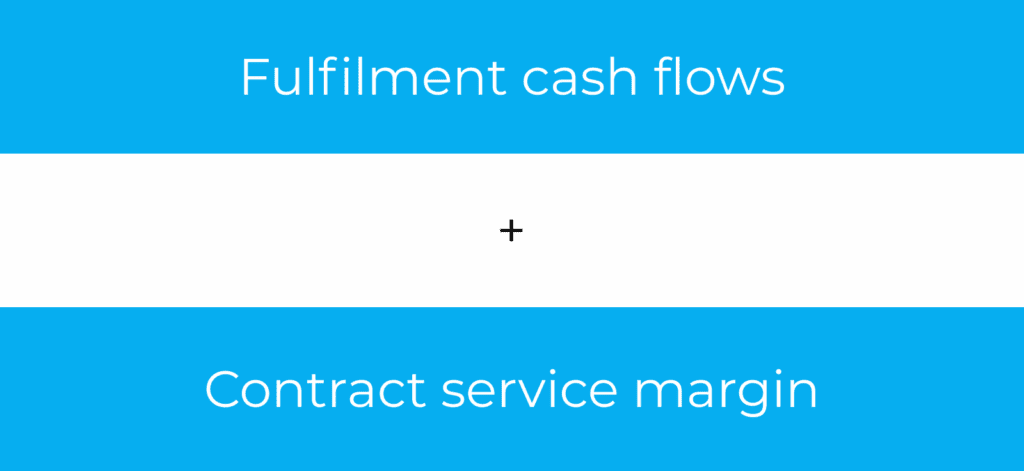
Fulfilment cash flows
Estimates of future cashflows within boundary of the insurance contracts in the group+ adjustment for time value of money + risk adjustment for non-financial risk.
Contract service margin (CSM)
Unearned profit to be recognized in future over life of the insurance contract. Other than for onerous contracts and reinsurance contracts, on initial recognition CSM is such that no ’day 1’ revenue or expense is recorded.
SUBSEQUENT MEASUREMENT
Balance sheet
- Insurance contract liability = LFRC (see above) + Liability for Incurred Claims (LIC)
- LIC = present value of future claims cash flows + risk adjustment
Income statement
- Insurance service result = Revenue from insurance coverage in period = reduction in LFRC
- Insurance service expenses = change in LIC + claims payments + claims handling related expenses
- Unwind of discount rates can be expensed as insurance finance expenses or recorded in other comprehensive income
SIMPLIFICATION FOR SHORT-TERM CONTRACTS
An entity can simplify the measurement of LFRC for a group using the ‘premium allocation approach’ (PAA) if:
- the resulting LFRC does not differ materially from that resulting from the GMM approach; or
- the coverage period of each contract in the Group does not exceed one year.
Under the PAA LFRC = simplified measurement based on unearned premiums and LIC = fulfillment cashflows (no discounting if due within one year) + risk adjustment.
REINSURANCE CONTRACTS
The GMM is also applied to reinsurance contracts. However, this will generally result in a reinsurance asset being recognised as the expected cash flows under the contract will likely be expected cash inflows rather than outflows.
Reinsurance contracts can also be measured under the PAA approach if the criteria above are met.
DISCLOSURES
A reconciliation of the movement in in the net carrying amount of insurance contracts during the period must be provided. Significant quantitative and qualitative disclosures are required regarding the judgements and assumptions used in applying IFRS 17 as well as the nature and extent of risks associated with insurance contracts.
CONTACTS
| BOAZ DAHARI Moore Israel [email protected] | KRISTEN HAINES Moore Australia [email protected] | TAN KEI HUI Moore Malaysia [email protected] |
| CHRISOF STEUBE Moore Singapore [email protected] | NEES DE VOS Moore DRV [email protected] | TESSA PARK Moore Kingston Smith [email protected] |
| EMILY KY CHAN Moore CPA Limited [email protected] | PAUL CALLAGHAN Moore Oman [email protected] | THEODOSIOS DELYANNIS Moore Greece [email protected] |
| IRINA HUGHES Johnston Carmichael [email protected] | SAHEEL ABDULHAMID Moore JVB LLP [email protected] |
MOORE IFRS in Brief is prepared by Moore Global Network Limited (“Moore Global”) and is intended for general guidance only. The use of this document is no substitute for reading the requirements in the IFRS® Accounting Standards issued by the International Accounting Standards Board (IASB). This document reflects requirements applicable as at the date of publication, any amendments applicable after the date of issuance, to the IFRS® Accounting Standards have not been reflected. Professional advice should be taken before applying the content of this publication to your particular circumstances. While Moore Global endeavors to ensure that the information in this publication is correct, no responsibility for loss to any person acting or refraining from action as a result of using any such information can be accepted Moore Global.